
In the Appointed Season (Part 1): The Prophetic Timeline of the Fall Feasts
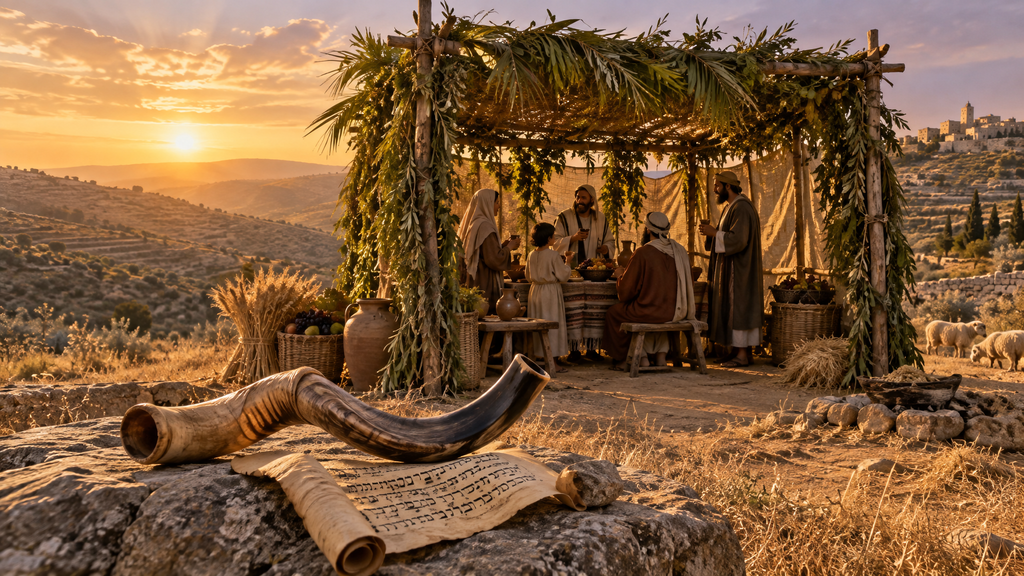
Stepping into the Father’s season—from the shofar’s blast to the sacred dwelling of Sukkot.
Genesis 17:5 (KJV)
“Neither shall thy name any more be called Abram, but thy name shall be Abraham; for a father of many nations have I made thee.”
When we study the Hebrew word for “set time” or “appointed season,” we encounter H4150 (mo’ed), which denotes an appointed place, an appointed time, a sacred season, or a set feast. It stems from the primitive root H3259 (yāʿad), meaning to fix, designate, assemble, gather by appointment, or engage.
“Abba doesn’t go back on His words, and His words don’t return to the void. But it happens at His set time, not at man’s time.”
Welcome to the midweek message. I proclaim Sukkot.
This message has been on my heart and in my mind since the Sabbath, which was also Tishri 1. It came from deep study and research. When I woke up Monday, Abba pressed upon me: “You’ve got something to write.” But it is more than writing—it is a word for now, because we are standing in an appointed season.
The Three Great Pilgrim Seasons
Scripture outlines three major appointed Holy seasons, each tied to a divine revelation:
Pesach (Passover): The season for God the Son, Adonai, the Word made flesh.
Shavuot (Pentecost): The season for God the Holy Spirit, Ruach HaKodesh.
If you follow my writings on Substack, you have seen glimpses of what I’ve learned—it’s truly been a season of spiritual liberation for me.
Sukkot (Tabernacles): The Father’s season, Yahweh’s season.
Sukkot is the longest of the three seasons, spanning three full weeks of holy convocations. It is also the only season with two distinct parts, one of which has not yet fully manifested in human history.
My apostle, when I was learning this, would always say, “The first shall be last, and the last shall be first,” because of how this season is honored and how its promises unfold.
The Awakening Blast of Yom Teruah
We begin the season on Tishri 1 with Yom Teruah (the Day of Trumpets).
Our Jewish brothers and sisters call it Rosh Hashanah. They observe it over two days because, historically, when calendar calculations relied solely on sighting the sliver of the new moon from Jerusalem, witnesses had to verify when the previous month ended and Tishri began. To ensure compliance, they honored both days. Although modern astronomy pinpoints the day precisely, ancestral custom has preserved the two-day observance for many. For those of us honoring the biblical mandate directly, Tishri 1 is Tishri 1, and we honor it on that day.
On this day, we hear the shofar’s blast. The shofar—crafted from a ram’s horn—was sounded in times of war with specific calls. It was blown at the start of the biblical feasts with sacred cadences. In the wilderness, it signaled when the cloud of Elohim/God lifted, prompting the camp to move, or settled, indicating they should remain. It also points us to the miraculous dedication and rededication of sacred spaces, reminding us of Yahweh’s sustaining power, much like the oil that miraculously burned for eight days in the temple menorah.
For those who study eschatology, when YahShua HaMashiach (Jesus Christ of Nazareth) returns, His arrival and the gathering of the saints will be heralded by the heavenly trumpet. We do not know the exact day or hour, but He revealed the season. We practice listening for Yahweh’s sound in the shofar. We memorialize and rehearse it so we are not caught off guard or found foolishly wanting when the Bridegroom arrives.
The 10 Days of Introspection and Yom Kippur
Tishri 1 marks the civil new year on the Hebrew calendar—the tradition that human creation was completed on the sixth day, when Yahweh declared everything “very good.” (As of Tishri 1, we now stand in the year 5787 on the Hebrew calendar.)
More importantly, Tishri 1 initiates ten days of solemn introspection leading up to Yom Kippur (the Day of Atonement). We appear before Yahweh in reverence. Although final judgment is reserved, this period prompts us to examine where we have fallen short and where we have grown over the past 300-plus days.
We must ask ourselves:
Is Yahweh pleased with our walk this past year?
Are our actions showing that we are truly His children, or are we living like children of this world?
Have we forgotten that we are merely pilgrims passing through, and instead abandoned our heavenly citizenship?
Every word spoken and every deed done will be weighed. On the final day, our works will be tested by fire. If what we built was wood, hay, or stubble, it will burn away. If it was gold, silver, or precious stones, it will endure. Our stewardship here determines our authority in the Kingdom. Remember the parable of the talents: those who were faithful with what they were given were granted greater responsibility, while the one who buried his talent lost everything. What is bound on earth is bound in heaven.
The Indwelling and the Manifestation: Tishri 15 to Tishri 22
Then we move into the heart of the festival: the Feast of Tabernacles (the Feast of Ingathering), observed from Tishri 15 to Tishri 22 and culminating in the great eighth day of sacred assembly, Tishri 22.
It commemorates the wilderness journey, during which the children of Israel dwelt in booths beneath the divine cloud of glory. In the Gospel accounts, we understand that this season also marks the physical birth of our Savior, YahShua HaMashiach, who was circumcised on the eighth day.
“The seed promised from the beginning was wrapped into flesh and tabernacled among us.”
The seed promised from the beginning was wrapped in flesh and tabernacled among us. The final part of the Sukkot mystery has already entered human history through His first coming, which opened the way for Pesach.
Isaiah prophesied: “For unto us a child is born [YahShua], unto us a son is given [Adonai].” Everything we see fulfilled in the New Covenant was already sown as seed in the Torah. Genesis holds the blueprint for all that follows. Exodus 12 foreshadows the death and burial of Pesach. Leviticus and Numbers detail the harvest pattern of Shavu’ot. And in Abraham’s seed, the blueprint for the appointed time was etched into eternity.
In Part 2, we will examine why the story of Isaac holds the key to understanding your own appointed season—and why rushing God’s calendar only breeds strife.