
The Lamb They Loved: A Pesach Story
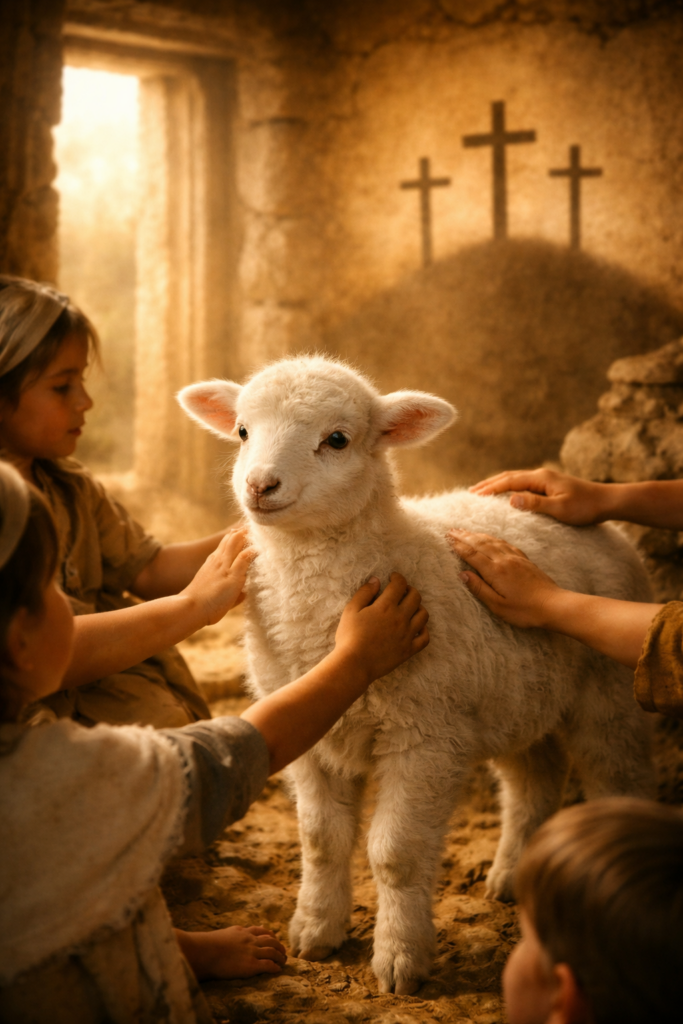
The lamb was selected four days ago; it had to be protected as our precious gift.
Its fleece must stay white; its bones cannot be broken. It must be fed with the finest of grains.
Now the feast is upon us, Father has called for us to cook this lamb.
The children are crying.
They now love this lamb.
They don’t understand how its death will bring healing, protection, and salvation to our village.
To our home.
The men come and take and kill this precious lamb.
They score this lamb skin and rub it with special oils.
Other than shaving its fleece and draining its blood, they leave the lamb whole.
They drive skewers through its paws and place it before the fire to roast.
What the children do not understand at this time is why our village honors this tradition.
It is not an old folk tale or a tradition without merit.
It is a Kingdom mandate, a biblical instruction to be carried out forever.
It traces back to our founding brother, Moses.
It was perfected over 2000 years ago.
This coincided with the manifestation of our forefather Abraham’s prophecy.
The prophecy stated, “Elohim/God will provide himself a lamb for a burnt offering.”
The Son of Man was found guilty by no fault of his own.
He was then sentenced to death. His clothing was removed.
The guards prepared cat o’nine-tails to rip open his skin throughout the night.
Thankfully, he was anointed earlier with special oils in preparation for this day.
They made him carry his cross to the top of the hill.
Then they drove nails in his palms and nails in his feet.
His blood covered all three legs of the cross.
It was just like the blood that covered all three sides of the door on the very first Passover night.
They lifted him high in front of the hottest fire in the world to roast him.
The Son of Man, the precious Lamb of Elohim.
Sent from heaven to earth, to carry the Word.
To be the final sacrificial offering for our sins.
Before his death, he had a final dinner with his disciples.
During this dinner, he told them he would eat this meal again with them in His Father’s House.
For this reason, we must continue to honor this meal.
The wine represents the blood he shed for our sins.
The bread symbolizes his flesh.
The lamb signifies the restoration of our energy.
The bitter herbs reflect the sin in the world.
The salt water symbolizes washing away the sin.
I PROCLAIM PESACH!